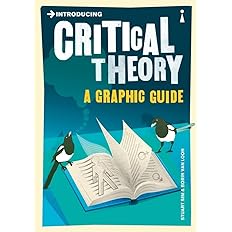
Description
summary of Introducing Critical Theory: A Graphic Guide by Stuart Sim — a visual, accessible introduction to the major ideas, thinkers, and contexts of critical theory.
📘 Overview
Introducing Critical Theory is part of the Graphic Guides series. It uses illustrations, timelines, and diagrams to explain the development and key concepts of critical theory — a school of thought that critiques society, culture, power structures, and ideology. Stuart Sim presents dense theoretical material in an engaging, visual format, making complex ideas accessible to beginners.
🧠 What Critical Theory Is
Critical theory originated with the Frankfurt School in early 20th-century Germany. Rather than describing how society is, it seeks to critique and transform society, especially power imbalances, hierarchies, and systems of domination.
Three core features:
-
Critique of ideology — how ideas can serve power rather than truth
-
Emphasis on emancipation — freeing people from oppression
-
Interdisciplinary approach — philosophy, sociology, psychology, culture, media
📜 Historical Development (Key Periods & Figures)
🔹 Frankfurt School (1920s–1960s)
-
Max Horkheimer & Theodor Adorno — Dialectic of Enlightenment: society’s rationality can turn into domination.
-
Herbert Marcuse — critique of consumer culture and one-dimensional thought.
-
Walter Benjamin — culture and aesthetics as sites of resistance.
🔹 Post-Structuralism & French Theory (1960s–1980s)
-
Michel Foucault — power is diffuse, not centralized; knowledge and power shape each other.
-
Jacques Derrida — deconstruction of texts and binaries.
-
Julia Kristeva & Roland Barthes — language, semiotics, subjectivity.
🔹 Later Developments
-
Jürgen Habermas — communicative rationality, democratic discourse.
-
Jürgen Habermas and others engage with modernity and critique of critical theory itself.
🧩 Key Concepts Explained
The book breaks down fundamental ideas such as:
📏 Ideology
Systems of beliefs that appear natural but serve particular interests (e.g., media shaping how we see “normal”).
🌀 Hegemony
Gramsci’s idea: dominant groups maintain power through cultural consent, not just force.
🧠 Subjectivity
How the self is constructed by language, culture, institutions (not a fixed, isolated entity).
🧱 Power/Knowledge
Foucault: knowledge isn’t neutral — it’s shaped by power and reinforces power.
🔍 Deconstruction
Derrida’s method of revealing hidden assumptions in texts and concepts.
🎭 Culture Industry
Adorno & Horkheimer’s idea that mass culture pacifies and manipulates audiences.
🎨 Graphic Format — Why It Matters
Visual storytelling in the book:
-
Timelines to map historical connections
-
Cartoons & metaphors to explain abstract theory
-
Diagrams to show how concepts relate
-
Quotes paired with visuals to aid memory
This format helps demystify thinkers who are often seen as dense or inaccessible (e.g., Adorno, Derrida, Foucault).
📌 Takeaway Messages
-
Critical theory is about questioning assumptions and power structures in society.
-
It spans multiple thinkers and eras, but consistently aims to uncover hidden forces shaping our world.
-
The graphic guide makes these ideas approachable without dumbing them down.
🤔 Who Is It For?
-
Students new to theory
-
Readers intimidated by traditional academic texts
-
Anyone interested in culture, politics, media, ideology, power
Reviews
There are no reviews yet.